An Engineering Perspective on Durable Pool Structures
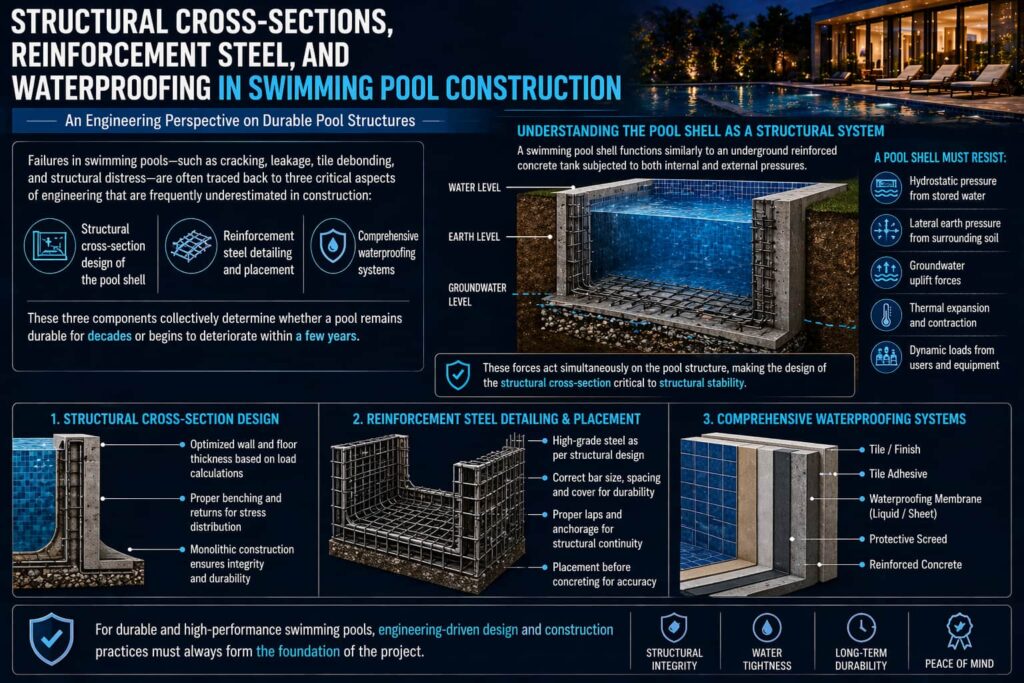
Failures in swimming pools—such as cracking, leakage, tile debonding, and structural distress—are often traced back to three critical aspects of engineering that are frequently underestimated in construction:
- Structural cross-section design of the pool shell
- Reinforcement steel detailing and placement
- Comprehensive waterproofing systems
These three components collectively determine whether a pool remains durable for decades or begins to deteriorate within a few years.
Understanding the Pool Shell as a Structural System
A swimming pool shell functions similarly to an underground reinforced concrete tank subjected to both internal and external pressures. Unlike ordinary slabs or retaining walls, a pool shell must resist:
- Hydrostatic pressure from stored water
- Lateral earth pressure from surrounding soil
- Groundwater uplift forces
- Thermal expansion and contraction
- Dynamic loads from users and equipment
These forces act simultaneously on the pool structure, making the design of the structural cross-section critical to structural stability.
For durable and high-performance swimming pools, engineering-driven design and construction practices must always form the foundation of the project.