
An Engineering Perspective on Structural Stability and Pool Safety
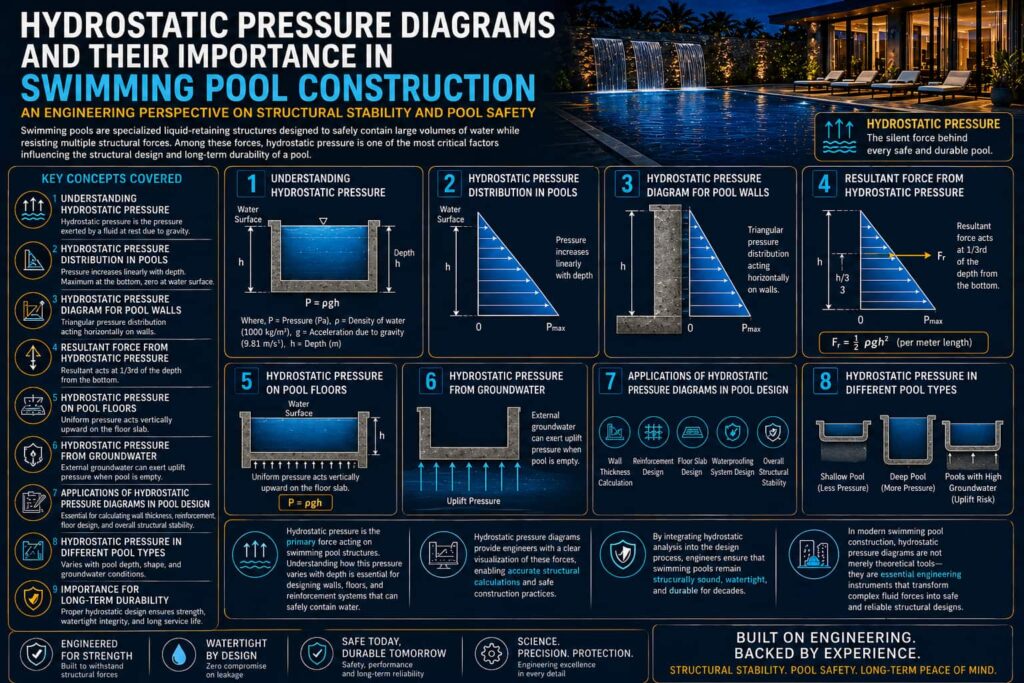
Swimming pools are specialized liquid-retaining structures designed to safely contain large volumes of water while resisting multiple structural forces. Among these forces, hydrostatic pressure is one of the most critical factors influencing the structural design and long-term durability of a pool.
Key Engineering Concepts
- Understanding hydrostatic pressure
- Hydrostatic pressure distribution in pools
- Hydrostatic pressure diagram for pool walls
- Resultant force from hydrostatic pressure
- Hydrostatic pressure on pool floors
- Hydrostatic pressure from groundwater
- Applications of hydrostatic pressure diagrams in pool design
- Hydrostatic pressure in different pool types
- Importance for long-term durability
Conclusion
Hydrostatic pressure is the primary force acting on swimming pool structures. Understanding how this pressure varies with depth is essential for designing walls, floors, and reinforcement systems that can safely contain water.
Hydrostatic pressure diagrams provide engineers with a clear visualization of these forces, enabling accurate structural calculations and safe construction practices.
By integrating hydrostatic analysis into the design process, engineers ensure that swimming pools remain structurally sound, watertight, and durable for decades.
In modern swimming pool construction, hydrostatic pressure diagrams are not merely theoretical tools—they are essential engineering instruments that transform complex fluid forces into safe and reliable structural designs.