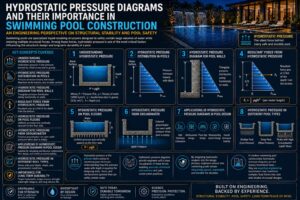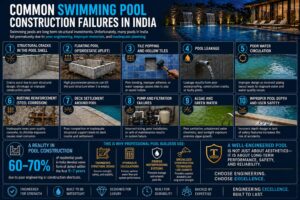
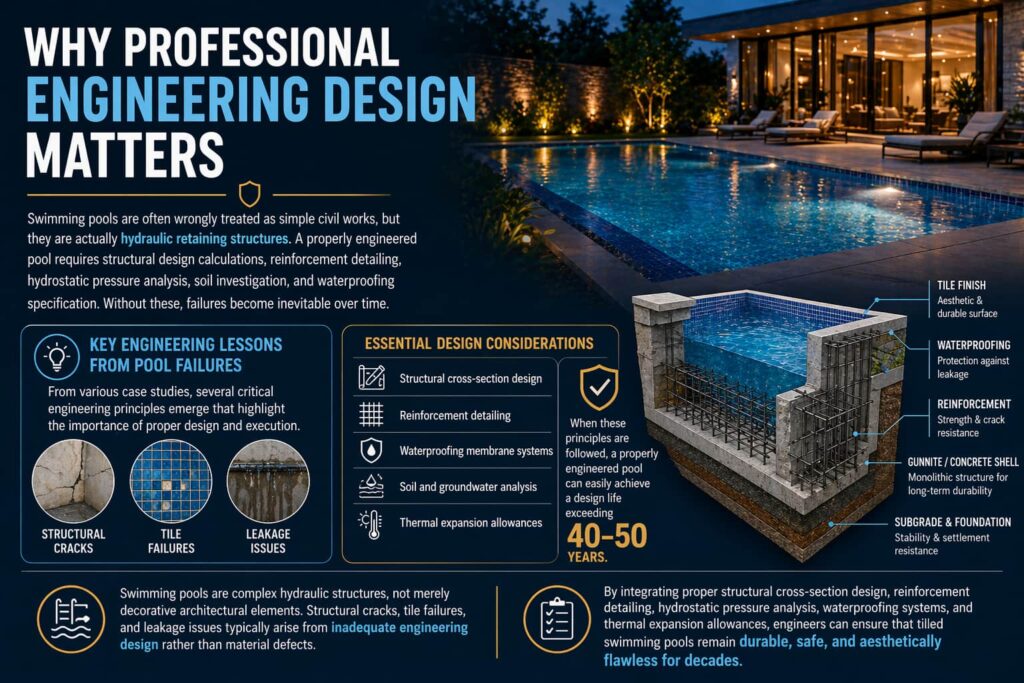
Swimming pools are often wrongly treated as simple civil works, but they are actually hydraulic retaining structures. A properly engineered pool requires structural design calculations, reinforcement detailing, hydrostatic pressure analysis, soil investigation, and waterproofing specification. Without these, failures become inevitable over time.
Key Engineering Lessons from Pool Failures
From various case studies, several critical engineering principles emerge that highlight the importance of proper design and execution.
Essential Design Considerations
- Structural cross-section design
- Reinforcement detailing
- Waterproofing membrane systems
- Soil and groundwater analysis
- Thermal expansion allowances
When these principles are followed, a properly engineered pool can easily achieve a design life exceeding 40–50 years.
Swimming pools are complex hydraulic structures, not merely decorative architectural elements. Structural cracks, tile failures, and leakage issues typically arise from inadequate engineering design rather than material defects.
By integrating proper structural cross-section design, reinforcement detailing, hydrostatic pressure analysis, waterproofing systems, and thermal expansion allowances, engineers can ensure that tiled swimming pools remain durable, safe, and aesthetically flawless for decades.